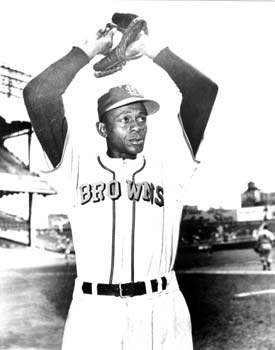
Remembering a great man

"I don’t want people to be sad when I die. I’ve lived a full life. Be sad for the kids who die.”
He was just sitting there. When we walked into the Negro League Baseball Museum on an October Friday afternoon, Buck O'Neil was sitting in a little booth smiling. My friend, who was traveling with me turned to me. Is that Buck O'Neil.
It was. We walked over to talk and he seemed glad we did. He told a few stories and answered a few of our questions and lived up to his reputation as a class act, a gentleman and fun guy to talk to. I treasure the memory.
Buck O'Neil died Friday. Baseball will miss him a lot.
Below are some reflections on the man. I hope to add more on Sunday. Below that is his speech about the Negro Leagues that he gave at Cooperstown.
ESPN's Wright Thompson weighs in.
I'm sure the Kansas City Star's Joe Posnanski, who is writing a book about O'Neil, has known he'd be writing this column about O'Neil for years. He nailed it.
The KC Star has a great special section on O'Neil.
This is outstanding. I've been a lot of places, I've done a lot of things that I really liked doing. I hit the home run, I hit the grand slam home run, I hit for the cycle, I've hit a hole in one in golf. I've done a lot of things I like doing. Oh, man. I took along with the other president and I got to hug his wife Hillary, so I've done a lot of things I like doing, but I'd rather be right here right now representing these people that helped build a bridge across the chasm of prejudice, not just the ones like Charley Pride and me that lead across it. Yeah.
This is quite an honor for me. See, I played in the Negro leagues. Tell you what, the Negro leagues was nothing like Hollywood is trying to make it. The Negro leagues was the third- largest black business in this country. Yeah. First black insurance, white insurance. It was a ten cent policy, just enough to bury us, but the black insurances insured our crops, our homes. Yeah. Stock, they made millions.
Next, Madam C.J. Walker, cosmetology. You see that pretty hair over there, don't you see it? Mrs. Robinson. Tell you what, yeah, that's right. Madam C.J. Walker was doing that a hundred years ago and she made millions. To tell you the truth, Madam C.J. Walker was the first black woman millionaire in this country and to tell you, Madam C.J. Walker might have been the first woman millionaire in the country that earned it. They had other women millionaires but they inherited the money. Madam C.J. Walker earned it.
Next, Negro league baseball. All you needed was a bus, and we rode in some of the best buses money could buy. Yeah. And a couple of sets of uniforms. You could have 20 of the best athletes that ever lived, and that's who we are representing here today. It was outstanding.
And playing in the Negro leagues was a lot, which a lot of you don't know, see, when I first came to the Negro leagues, five percent of major league ball players were college men because the major leaguers wanted them right out of high school, put them in the minor league, bring them on in. But Negro leagues, 40 percent of Negro leagues, leaguers, were college men. The reason that was, we always spring trained in a black college town and that's who we played in spring training, the black colleges, so when school was out, they came and played baseball. When baseball season was over, they'd go back to teaching, the coaching or to classes. That was Negro league baseball. And I'm proud to have been a Negro league ball player. Yeah, yeah.
And I tell you what, they always said to me Buck, I know you hate people for what they did to you or what they did to your folks. I said no, man, I never learned to hate. I hate cancer. Cancer killed my mother. My wife died 10 years ago of cancer – I'm single, ladies. I hate AIDS. A good friend of mine died of AIDS three months ago. I hate AIDS. But I can't hate a human being because my God never made anything ugly. Now, you can be ugly if you want to, boy, but God didn't make you that way.
So I want you to light this valley up this afternoon. Martin [Luther King] said "Agape" is understanding, creative – a redemptive good will toward all men. Agape is an overflowing love which seeks nothing in return. And when you reach love on this level, you love all men, not because you like them, not because their ways appeal to you, but you love them because God loved them, and I love Jehovah my God with all my heart, with all my soul and I love every one of you as I love myself.
Now, I want you to do something for me. I'm going to get off this stage, I think I've done my six minutes. But I want you to do something for me. I want you to hold hands, whoever's next to you, hold a hand, come on, you Hall of Famers, all you people out there, hold hands.
Everybody hooked up? Everybody hooked up? Well then I tell you what, see, I know my brothers up here, my brothers over there, I see some black brothers of mine and sisters out there. I know they can sing. Can you white folks sing? I want you to sing after me:
(Singing began) The greatest thing, come on everybody, the greatest thing, in all of my life, is loving you. The greatest thing in all of my life is loving you. The greatest thing in all of my life is loving you. The greatest thing in all my life is loving you. (Singing ended)
Thank you folks, thank you folks, thank you folks, thank you folks, thank you, thank you, thank you, thank you, thank you, thank you. Now, sit down. I could talk to you 10 minutes longer but I got to go to the bathroom.
Labels: Posnanski
posted by Matt Vautour @ 11:50 PM
0 comments